Showing posts with label Logic/Logique. Show all posts

Monday, 18 October 2010

En l'honneur de Gerhard Heinzmann

Pierre Edouard Bour, Manuel Rebuschi, Laurent Rollet are the editors of a book published for celebrating Gerhard Heinzmann's works. Here is the description :

This Festschrift is published on the occasion of Gerhard Heinzmann's 60th birthday. Its title "Construction" refers to Heinzmann's philosophical options (intuitionism, dialogical pragmatism, constructivism), as well as to his exceptional involvement in the building of many scientific enterprises and new scientific institutions. Sixty authors contributed to the volume, and the gathered essays witness the various centers of interest and intellectual achievements of Heinzmann. They are organized in five sections: (1) Henri Poincaré; (2) History and Philosophy of Mathematics; (3) History and Philosophy of Logic; (4) Pragmatism; and (5) Miscellaneous.

Contributors :
Evandro Agazzi, Michael Astroh, Hervé Barreau, Thomas Bénatouïl, Denis Bonnay, Hélène Bouchilloux, Pierre Edouard Bour, Michel Bourdeau, Christophe Bouriau, Christiane Chauviré, Michael Detlefsen, Pascal Engel, Dominique Fagnot, Virginie Fiutek, Didier Galmiche, Paul Gochet, Jeremy Gray, Marcel Guillaume, Jaakko Hintikka, Bertram Kienzle, Ralf Krömer, Jacques Lambert, Dominique Larchey-Wendling, Philippe Lombard, Kuno Lorenz, Igor Ly, Ulrich Majer, Mathieu Marion, Alexandre Métraux, Michel Meulders, Philippe Nabonnand, Michel Paty, Roger Pouivet, Joelle Proust, Shahid Rahman , Narahari Rao , Manuel Rebuschi, Laurent Rollet, Séverine Rollet, Giuseppina Ronzitti, Philippe de Rouilhan, Helge Rückert, Fabien Schang, Anne-Françoise Schmid, François Schmitz, Elisabeth Schwartz, Hourya Sinaceur, Antonia Soulez, Claudine Tiercelin, Richard Tieszen, Frédérick Tremblay, Tero Tulenheimo, Johan van Benthem, Louis Vax, Denis Vernant, Joseph Vidal-Rosset, Henk Visser, Klaus Volkert, Gudrun Vuillemin, Scott Walter.

Pierre Edouard Bour, Manuel Rebuschi Laurent Rollet (ed.) (2010). Construction. Festschrift for Gerhard Heinzmann. College Publications.

Full table of content.

Saturday, 6 March 2010

Paraconsistent Foundations of Mathematics : a weblog.

Paraconsistent Foundations for Mathematics is a new blog created for a new project at the University of Melbourne. The project is under the direction of Pr. Graham Priest, Ass. Pr. Greg Restall, and a research associate Francesco Berto. Zach Weber is the author of the blog. I am looking forward to read the next posts !

(Introduction to Paraconsistent Logic.)

Saturday, 31 October 2009

Quinean dogma : analyticity and syntheticity

A discussion of the famous "Two Dogmas of Empiricism" written by Quine (republished in From a Logical point of View).

(Version française)


The two dogmas are the following :

  1. There exists a fixed and determined criterion for the distinction between analytic propositions and synthetic propositions.
  2. Reductionnism is true. (Reductionnism is a interpretation of verificationism. Verificationism is the thesis that the meaning of a proposition is the method by which the proposition is confirmed or infirmed ; reductionism is the method by immediate experience that infirms or confirms a proposition.)


According to Quine, the two dogmas are correlated. Take the proposition "2+2=4". It is true whatever are the circumstances but nothing empirical can confirm or infirm it (it can only be exemplified). For Empiricism, as Quine understand it, this proposition has no meaning and contains only a linguistic part. Here is the theory of signification of Empiricism according to Quine : synthetic propositions are constituted by linguistic and factual aspects, as analytic propositions are constituted only by a linguistic aspect. If a proposition is meaningful, then it is a synthetic proposition. If the proposition has no specific meaning, and it is true whatever are the circumstances or false whatever are the circumstances, then it is an analytic proposition. Analyticity and syntheticity depend on the method of verification for every proposition taken individually.

How Quine addresses these dogmas ? Quine's reasoning is not easy to follow, but I think that the steps are the following. Here the first step of the reasoning. The topic is analytic propositions.

Step 1 :

1) Empiricists states that analyticity is the fact for a proposition to be true in virtue of the signification of the logical terms ("no", "every",...) of the proposition. (For ex., a proposition of the form "No x is non-x" is always true, whatever is the interpretation of the variable "x". Hereafter this type of proposition is named "class a".)
2) Empiricists (Carnap) states that there exists a class of proposition (class b) which are analytic in virtue of there logical components and of the meaning of the extra-logical components, and which can be reduced to propositions of class a. E.g. if y is synonymous of x, then the substitution of y to x, in the class a proposition P "No x is no-x", which permits us to form a class b proposition Q "No x is no-y", permits to form Q, which has the same meaning as P and which is analytic. When we say that a class b proposition Q is a synonymous interpretation of a class a proposition P, we mean that they have necessarily the same meaning and that Q is necessarily analytic.
3) But there are no plausible explanation (contradiction, definition, interchangeability salva veritate) of synonymy that can secure the fact that the substitution of extra-logical components that has been described preserves meaning and analyticity.
4) Thus Empiricists cannot states that there exist a class b propositions which must necessarily be analytic.

End of the first step. The capital consequence of this step is scepticism towards the theory of verification and its capacity to resolve the analyticity problem. Indeed, since analyticity and the theory of verification are two sides of the same coin, then, since we have established that signification is not sufficient to preserve analyticity, then the theory of verification may have not the means to explain analyticity.

Purpose of the second step : showing that there is no determined criterium between analytic propositions and synthetic propositions. Quine is wondering if the fact that an analytic statement is "analytic for" a given language may be true, such that the statement "the proposition S is analytic for language X", where S and X are variables whose field is limited to artificial languages, is true. Quine made a trial with a type of semantic rule, rejects it, then did a test with another rule. I followed literally his progress.

Step 2

1) Let us suppose that L' is an artificial language which has a semantical rule R which purpose is to discriminate the set of analytic propositions and the set of synthetic statements, that is to say to tell us that such statements are analytic and only those, and such statements are synthetic and only those.
2) But the rule R allows us only to recognize which statements are the analytical and which ones are the synthetic propositions, without defining analyticity. In other words, there is an ostensive definition of analyticity ("this set of statements") in L ', but not an intensional definition or a definition of the meaning of "analytic" in "analytic for L'" .
3) Since one has a sufficient intuitive knowledge of analyticity to assume that all analytic propositions in L ' belong to a subset of all true propositions in L', then we can perhaps say that a proposition S is analytic iff S is not only true, but true according to a semantical rule T which says that such statements belong to the set of all true propositions.
4) Now the status of "semantic rule T" can not be attributed to any statement that says that statements of a certain class are true, because all true statements consistent with T would be analytic. We must assume that the status of "semantic rule T" can only be attributed to certain classes of these truths. Yet all true statements can claim the status of "semantical rule T" since no true statement does intrinsically possess the property of being " the semantical rule T". In other words, the notion of "semantical rule T" is relative to an order of exposure of a given language. Therefore, if the notion of "semantical rule T" is the criterion to define analyticity, then all statements may claim the status of analytic proposition and classes of analytic propositions are relative to the order selected to describe L'.
5) Therefore, since there is no semantical rule that can establish a determined distinction between analytic and synthetic propositions, then analyticity is not a property that pertain "essentially" to a class of propositions.


End of the second step. Basically Quine has shown that there is no intrinsically fixed criterion for discriminating analytical propositions. Yet we remember that Quine argues that the second dogma of Logical Empiricism is the thesis of reductionism as an interpretation of the theory of verification. Quine does not abandon the theory of verification as a theory of signification, but he wants to refute reductionism as an interpretation of the theory of verification. This is the step 3 of his reasoning.


Step 3

1) If reductionism is true, then the meaning of a proposition is the immediate experience -which is the method of verification- that confirms or infirms this proposition.
2) If immediate experience as a method of verification is true, then an analytic proposition is the extreme case in which the proposition is confirmed (or infirmed) whatever are the immediate experiences, and a synthetic proposition is the case in which the meaning of a given proposition is established in respect of an isolated immediate experience alone and is confirmed or infirmed only relatively to this immediate experience.
3) If the thesis that the meaning of an isolated synthetic proposition is established by an immediate experience alone is true, then there are rules that correlate such isolated immediate experiences with their corresponding proposition.
4) But there is no rule that can make this correlation.
5) So reductionism is not true.


What are the consequences of this demonstration? 1) It is not possible to define analyticity as what is always empirically verifiable. 2) The division between the factual component and the linguistic component of a proposition is not as good as we thought. Indeed, we do not have at our disposal a criterion that can discriminate what makes a proposition a true proposition and the logical component. 3) There is no clear distinction between proposition based on facts and others not based on facts. In other words, there is no clear separation between natural science and metaphysics (in the sense of "speech that claims to be scientific but is not based on facts ").


I suppose that Quine is making another reasoning in the last part of his paper that is implied by his holism and that can be presented in the following manner :


Step 4


1) The entire body of our scientifical beliefs is a logically structured totality (our knowledge is true if and only if all our scientifical beliefs are true together : the logical operator between all propositions held true is a conjunction).
2) A conflict between experience and our beliefs leads to adjustments in the entire "field" of our beliefs (the truth values are redistributed).
3) Empiricists's theories are refuted by experiences and theoretical examination.
4) So scepticism upon all of the statements held true by Empiricists must be maintained until a satisfactory and complete redistribution of truth values is done.

Question: is Quine just stating an absolute truth? No! Here are some ways to address his reasoning.

The first way, the least interesting, is to notice that anyway, before 1950, Carnap, the leading advocate of verificationism, had abandoned the defense of reductionism. At that time Empiricism was already in an advanced revisionist phase because of/thanks to Carl Hempel.To put it in a nutshell, it means that Quine's paper is about an obsolete topic.

The second way is more interesting than the first . We can address the premise 3 of the first argument, which asserts that there is no plausible explanation of synonymy. Indeed, Quine's criticism is based on the distinction between extensional and intensional languages, ta distinction he has developed from the 1940s (see especially the chapter "Reference and Modality" in From a Logical Point of View). A language is extensional iff, a) when A and B are two terms or formulas of this language and A contains B, b) if B' has the same extension as B, c) if A' is the result of replacing B by B', d) then the extension of A' is the same as the extension of A. A language is intensional if it fails to meet these conditions. An extensional language has a limit. Take the proposition T : "All the rabbits and only the rabbits are necessarily rabbits. " T is an analytic proposition, even if it has no strict definition of" necessarily ". If we say "rabbit" and "domestic hare" are synonyms then we say that the proposition T ' "All the rabbits and only rabbits are necessarily domestic hare" is analytic. The adverb "necessarily" is the origin of the problem : what is the aspect of "necessarily" that can garantee us that T and T' have the same meaning, that the extension is the same in T and in T'. The problem is that if we answer that we know the meaning of necessity, then we already know what analyticity is. So the argument is circular. What we can do is criticizing Quine for rejecting completely intensional languages! Has he ever ask if there can be an answer to the question of whether there is a determined distinction between analytic and synthetic propositions in intensional languages? No!

Another way would be to say that Quine confuses analyticity and a priori in some parts of his paper (step 3 of my presentation). Indeed, in the first section of his article, he proposes the following definition of analytic propositions "a statement is analytic when it is true in virtue of meanings" (Part 1: Perspectives on the analyticity). But later, analytical statements are "true in all circumstances" (Part 6: Empiricism without dogmas). The first definition of analyticity given by Quine fits the definition of analyticity in semantical terms, but the second is very remote from this fitness. Using the experience to distinguish what is independant from experience and what is dependent of it permits to discriminate (and not define) a priori and a posteriori, but not to discriminate analyticity and syntheticity, let alone define it. (On a priori and analyticity, see also the recent post by Florian Cova on the a priori and the debates it has provoked.)


A fourth way would be to distinguish between metaphysical analyticity and epistemic analyticity: "According to the metaphysical concept, a sentence is analytic if it owes its truth entirely to its meaning and without any contribution from the 'facts'. By contrast, I took a sentence to be epistemically analytic if grasp of its meaning can suffice for justified belief in the truth of the proposition express it. "wrote Paul Boghossian in his article" Epistemic Analyticity: A Defense ". This article and "Analyticity Reconsidered" are available on his homepage.

A fifth way would be to address the premises 1-2 of the fourth step of my presentation, that is to say, Quine's holism. But that will probably the topic of my next post !


Do you see other weakness in Quine's reasoning ? Or do you think my presentation does not do justice to Quine's paper ? Or do you think that we must defend Quine's paper ?

W. V. O. Quine, "Two Dogmas of Empiricism", Philosophical Review, 60/1 (Jan. 1951) ; 20-43.

W. V. O. Quine (1953), From a Logical Point of View. Nine Logico-Philosophical Essays. Harvard University Press.


Friday, 27 March 2009

Philosophy and Foundations of Mathematics : Epistemological and Ontological Aspects


SCAS, Uppsala, May 5-8, 2009. A conference dedicated to Per Martin-Löf on the occasion of his retirement.

Speakers include:

*Peter Aczel
*Mark van Atten
*Steve Awodey
*Thierry Coquand
*Peter Dybjer
*Juliet Floyd
*Jean-Yves Girard
*Sten Lindström
*Colin McLarty
*Per Martin-Löf
*Peter Pagin
*Erik Palmgren
*Jan von Plato
*Dag Prawitz
*Christine Paulin
*Aarne Ranta
*Michael Rathjen
*Giovanni Sambin
*Anton Setzer
*Stewart Shapiro
*Wilfried Sieg
*Sören Stenlund
*Göran Sundholm
*William Tait
*Jouko Väänänen


Scope and aim

The aim of the conference is to bring together philosophers, mathematicians, and logicians to penetrate current and historically important problems in the philosophy and foundations of mathematics. Swedish logicians and philosophers have made important contributions to the foundations and philosophy of mathematics, at least since the end of the 1960s. In philosophy, one has been concerned with the opposition between constructivism and classical mathematics and the different ontological and epistemological views that are reflected in this opposition. A central philosophical question concerns the nature of the abstract entities of mathematics: do they exist independently of our epistemic acts (realism, or Platonism) or are they somehow constituted by these acts (idealism)? Significant contributions have been made to the foundations of mathematics, for example in proof theory, proof-theoretic semantics and constructive type theory. These contributions have had a strong impact on areas of computer science, e.g. through Martin-Löf's type theory.

Two important alternative foundational programmes that are actively pursued today are predicativistic constructivism and category-theoretic foundations. Predicativistic constructivism can be based on Martin-Löf constructive type theory, Aczel's constructive set theory, or similar systems. The practice of the Bishop school of constructive mathematics fits well into this framework. Associated philosophical foundations are meaning theories in the tradition of Wittgenstein, Dummett, Prawitz and Martin-Löf. What is the relation between proof-theoretical semantics in the tradition of Gentzen, Prawitz, and Martin-Löf and Wittgensteinian or other accounts of meaning-as-use? What can proof-theoretical analysis tell us about the scope and limits of constructive and (generalized) predicative mathematics? To what extent is it possible to reduce classical mathematical frameworks to constructive ones? Such reductions often reveal computational content of classical existence proofs. Is computational content enough to solve the epistemological questions?

A central concern for the conference will be to compare the different foundational frameworks - classical set theory, constructive type theory, and category theory - both from a philosophical and a logical point of view. The general theme of the conference, however, will be broader and encompass different areas of philosophy and foundations of mathematics, in particular the interplay between ontological and epistemological considerations.


Venue

The workshop will take place at the Swedish Collegium for Advanced Study (SCAS), Linneanum, Thunbergsvägen 2, Uppsala, Sweden. Map of Uppsala with a walking path from the Central Station indicated.


Organization and programme committee

Peter Dybjer, Sten Lindström, Erik Palmgren (Chair), Dag Prawitz, Sören Stenlund, Viggo Stoltenberg-Hansen.


Programme

The scientific programme starts at 10.00 on Tuesday, May 5 and ends at 16.00 on Friday, May 8. A conference dinner is planned for Friday evening. More details about the programme will appear in a few weeks.


Attendance

Attendance is open, and there is no registration fee. However, anyone planning to attend should preregister by emailing PFM[at]math.uu.se no later than April 5, 2009.

Friday, 9 January 2009

Mathématiques et expérience: Bouveresse et Wagner

Je signale la parution d'un nouveau livre de Jacques Bouveresse. Ouvrage dirigé avec Pierre Wagner: Jacques Bouveresse et Pierre Wagner, éd., Mathématiques et expérience, 1918-1940, Paris, Odile Jacob, 2008.

Table des matières (cliquer sur "more?").

Introduction, par Pierre Wagner, p. 7

I – À la recherche d’une philosophie des mathématiques, p. 13

Mathématiques, analyticité et applicabilité Carnap 1927-1937, par Fabrice Pataut, p. 15

Carnap, l’Aufbau, et l’idée mathématique de structure, par Frédéric Patras, p. 33

Harvard 1940-1941 : Tarski, Carnap, Quine et la question d’un langage mathématique finitiste pour la science, par Paolo Mancosu, p. 55

II – Le problème de l’application, p. 95

Vérification et application selon Schlick, par Jocelyn Benoist, p. 97

Carnap et le concept d’application. Qu’est-ce qui est appliqué et à quoi cela l’est-il ? par Pierre Wagner, P. 119

Définitions implicites, définitions explicites et application des théories physiques, par Delphine Chapuis-Schmitz, p. 151

Le problème de l’application du calcul des probabilités à la réalité : Schlick, Feigl, Natkin, etc. par Jacques Bouveresse, p. 175

III – L’empirisme logique à l’épreuve de la physique mathématique, p. 209

Mesure et formation des concepts physiques. Rudolf Carnap et Norman Campbell, par Nadine de Courtenay, p. 211

La réception de la mécanique quantique par Reichenbach et le Cercle de Vienne, par Andreas Kamlah, p. 253

Les critères de la signification peuvent-ils expliquer l’indéterminisme ? Causalité et vérificationnisme en mécanique quantique chez Moritz Schlick, par Michael Stöltzner, p. 273

Philosophie, physique et fondements de la géométrie, par Michael Friedman, p. 303

Friday, 28 November 2008

Terence Tao, blogging and Mathematics


Terence Tao is Professor of Mathematics at UCLA.

His new book, Structure and Randomness, is excerpted from his excellent weblog "What's new"".

Terence Tao est professeur de Mathématiques à UCLA.

Son dernier livre, Structure and Randomness, est la version papier des billets publiés sur son excellent blog: What's new.


Friday, 19 September 2008

1907-2007: one hundred year of intuitionism

Le Centre Culturel International de Cerisy-La-Salle a accueilli le colloque "1907-2007: cent ans d'intuitionnisme", sous la direction de Pascal Boldini, Michel Bourdeau, Gerhard Heinzmann et Mark Van Atten, du mardi 5 juin au mardi 12 juin. Les invités étaient très prestigieux (Matthieu Marion, Jacques Dubucs, G. Heinzmann...).
Ce colloque sera publié aux éditions Verlag AG.

The workshop "1907-2007: one hundred year of Intuitionnism" took place at the Centre Culturel International de Cerisy-La-Salle, in june 2007, under the direction of Pascal Boldini, Michel Bourdeau, Gerhard Heinzmann and Mark Van Atten.
The papers will be published by Verlag AG.

About intuitionism.

You can have more informations about the workshop and the book by clicking "more".


The workshop
Mercredi 6 juin
Matin:
Dirk VAN DALEN: La biographie intellectuelle de Brouwer
Henk BARENDREGT: Brouwer et le mysticisme

Après-midi:
Alain MICHEL: Remarques sur la signification du supposé "semi-intuitionisme" français
Carl POSY: L'infini brouwerien


Jeudi 7 juin
Matin:
Conférence E. W. BETH
Per MARTIN-LÖF: La controverse Hilbert/Brouwer résolue?

Après-midi:
Philippe NABONNAND & Gerhard HEINZMANN: L'intuition chez Poincaré et Brouwer
Marcel GUILLAUME: De quelques contributions de mathématiciens du début du XXe siècle au débat sur les fondements


Vendredi 8 juin
Matin:
Richard TIESZEN: A l'intersection de l'intuitionnisme et de la phénoménologie
Bernd BULDT: Que nous dit le temps dans les mathématiques (intuitionnistes)?

Après-midi:
Mathieu MARION: Wittgenstein et Brouwer sur le sens et la preuve
Jacques DUBUCS: Vérité et expérience de la vérité


Samedi 9 juin
JOURNÉE DE REPOS


Dimanche 10 juin
Matin:
Jean FICHOT: L'interprétation fonctionnnelle de Gödel: constructivité et calculabilité
Douglas BRIDGES: Les "Reverse Mathematics" constructives

Après-midi:
Giovanni SAMBIN: Deux applications du constructivisme dynamique: le principe de continuité de Brouwer et les suites de choix dans la topologie formelle
Mitsu OKADA: Logique intuitionniste et logique linéaire


Lundi 11 juin
Matin:
Peter SCHRÖDER HEISTER: La justification opérative de la logique intuitionniste selon Lorenzen
Anton SETZER: Théorie de la démonstration et théorie des types de Martin-Löf

Après-midi:
Mohammad ARDESHIR: L'intuition chez Brouwer et Sührawardi
Charles McCARTY: Le nouvel intuitionnisme


Mardi 12 juin
Matin:
Göran SUNDHOLM & Mark VAN ATTEN: La bonne interprétation de la logique intuitionniste
Wim VELDMAN: Quelques applications du théorème de la barre de Brouwer


The Book

Préface, par Mark van ATTEN, Pascal BOLDINI, Michel BOURDEAU & Gerhard HEINZMANN


I. Brouwer and Brouwerian intuitionism

Another look at Brouwer's dissertation, par Dirk van DALEN

Brouwerian infinity, par Carl POSY

The new intuitionism, par Charles McCARTY

Truth and experience of truth, par Jacques DUBUCS

The proper explanation of intuitionistic logic: on Brouwer's demonstration of the Bar Theorem, par Göran SUNDHOLM & Mark van ATTEN

The intersection of intuitionism (Brouwer) and phenomenology (Husserl), par Richard TIESZEN

Brouwer on 'hypotheses' and the middle Wittgenstein, par Mathieu MARION

Brouwer's notion of intuition and theory of knowledge by presence, par Mohammad ARDESHIR

Buddhist models of the mind and the common core thesis on mysticism, par Henk BARENDREGT


II. Kindred spirits

Remarks on the supposed French 'semi-' or 'pre-intuitionism', par Alain MICHEL

Poincarré: intuitionism, intuition, and convention, par Gerhard HEINZMANN & Philippe NABONNAND

Some of Julius König's mathematical dreams in his New Foudations of Logic, Arithmetic, and Set Theory, par Marcel GUILLAUME

Gödel, constructivity, impredicativity, and feasibility, par Jean FICHOT

Lorenzen's operative justification of intuitionistic logic, par Peter SCHROEDER-HEISTER


III. Mathematical perspectives

The Hilbert-Brouwer controversy resolved?, par Per MARTIN-LÖF

Proof theory and Martin-Löf Type Theory, par Anton SETZER

Some remarks on linear logic, par Mitsuhiro OKADA

Two applications of dynamic constructivism: Brouwer's continuity principle and choice sequences in formal topology, par Giovanni SAMBIN

A reverse look at Brouwer's Fan Theorem, par Douglas BRIDGES

Some applications of Brouwer's Thesis on Bars, par Wim VELDMAN


Concluding remarks at the Cerisy conference, par Michael DUMMETT

A bibliography of L.E.J. Brouwer, par Dirk van DALEN


Saturday, 6 September 2008

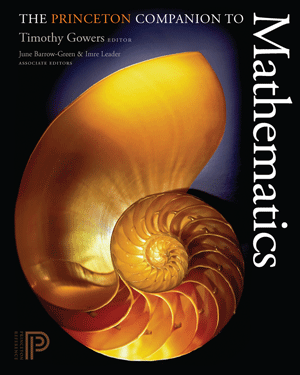
The Princeton Companion of Mathematics out in november!


A fabulous book is going to be published in november: The Princeton Companion to Mathematics, edited by Timothy Gowers, June Barrow-Green and Imre Leader, associate editors.

Notes:
1) There is a nice podcast with Th. Gowers in the Princeton Press' page.
2) You should have a look at Th. Gowers' weblog.

Full Table of Content: click on "More?".


TABLE OF CONTENTS:

Preface ix
Contributors xvii

Part I Introduction
I.1 What Is Mathematics About? 1
I.2 The Language and Grammar of Mathematics 8
I.3 Some Fundamental Mathematical Definitions 16
I.4 The General Goals of Mathematical Research 48

Part II The Origins of Modern Mathematics
II.1 From Numbers to Number Systems 77
II.2 Geometry 83
II.3 The Development of Abstract Algebra 95
II.4 Algorithms 106
II.5 The Development of Rigor in Mathematical Analysis 117
II.6 The Development of the Idea of Proof 129
II.7 The Crisis in the Foundations of Mathematics 142

Part III Mathematical Concepts
III.1 The Axiom of Choice 157
III.2 The Axiom of Determinacy 159
III.3 Bayesian Analysis 159
III.4 Braid Groups 160
III.5 Buildings 161
III.6 Calabi-Yau Manifolds 163
III.7 Cardinals 165
III.8 Categories 165
III.9 Compactness and Compactification 167
III.10 Computational Complexity Classes 169
III.11 Countable and Uncountable Sets 170
III.12 C*-Algebras 172
III.13 Curvature 172
III.14 Designs 172
III.15 Determinants 174
III.16 Differential Forms and Integration 175
III.17 Dimension 180
III.18 Distributions 184
III.19 Duality 187
III.20 Dynamical Systems and Chaos 190
III.21 Elliptic Curves 190
III.22 The Euclidean Algorithm and Continued Fractions 191
III.23 The Euler and Navier-Stokes Equations 193
III.24 Expanders 196
III.25 The Exponential and Logarithmic Functions 199
III.26 The Fast Fourier Transform 202
III.27 The Fourier Transform 204
III.28 Fuchsian Groups 208
III.29 Function Spaces 210
III.30 Galois Groups 213
III.31 The Gamma Function 213
III.32 Generating Functions 214
III.33 Genus 215
III.34 Graphs 215
III.35 Hamiltonians 215
III.36 The Heat Equation 216
III.37 Hilbert Spaces 219
III.38 Homology and Cohomology 221
III.39 Homotopy Groups 221
III.40 The Ideal Class Group 221
III.41 Irrational and Transcendental Numbers 222
III.42 The Ising Model 223
III.43 Jordan Normal Form 223
III.44 Knot Polynomials 225
III.45 K-Theory 227
III.46 The Leech Lattice 227
III.47 L-Functions 228
III.48 Lie Theory 229
III.49 Linear and Nonlinear Waves and Solitons 234
III.50 Linear Operators and Their Properties 239
III.51 Local and Global in Number Theory 241
III.52 The Mandelbrot Set 244
III.53 Manifolds 244
III.54 Matroids 244
III.55 Measures 246
III.56 Metric Spaces 247
III.57 Models of Set Theory 248
III.58 Modular Arithmetic 249
III.59 Modular Forms 250
III.60 Moduli Spaces 252
III.61 The Monster Group 252
III.62 Normed Spaces and Banach Spaces 252
III.63 Number Fields 254
III.64 Optimization and Lagrange Multipliers 255
III.65 Orbifolds 257
III.66 Ordinals 258
III.67 The Peano Axioms 258
III.68 Permutation Groups 259
III.69 Phase Transitions 261
III.70 p 261
III.71 Probability Distributions 263
III.72 Projective Space 267
III.73 Quadratic Forms 267
III.74 Quantum Computation 269
III.75 Quantum Groups 272
III.76 Quaternions, Octonions, and Normed Division Algebras 275
III.77 Representations 279
III.78 Ricci Flow 279
III.79 Riemann Surfaces 282
III.80 The Riemann Zeta Function 283
III.81 Rings, Ideals, and Modules 284
III.82 Schemes 285
III.83 The Schrödinger Equation 285
III.84 The Simplex Algorithm 288
III.85 Special Functions 290
III.86 The Spectrum 294
III.87 Spherical Harmonics 295
III.88 Symplectic Manifolds 297
III.89 Tensor Products 301
III.90 Topological Spaces 301
III.91 Transforms 303
III.92 Trigonometric Functions 307
III.93 Universal Covers 309
III.94 Variational Methods 310
III.95 Varieties 313
III.96 Vector Bundles 313
III.97 Von Neumann Algebras 313
III.98 Wavelets 313
III.99 The Zermelo-Fraenkel Axioms 314

Part IV Branches of Mathematics
IV.1 Algebraic Numbers 315
IV.2 Analytic Number Theory 332
IV.3 Computational Number Theory 348
IV.4 Algebraic Geometry 363
IV.5 Arithmetic Geometry 372
IV.6 Algebraic Topology 383
IV.7 Differential Topology 396
IV.8 Moduli Spaces 408
IV.9 Representation Theory 419
IV.10 Geometric and Combinatorial Group Theory 431
IV.11 Harmonic Analysis 448
IV.12 Partial Differential Equations 455
IV.13 General Relativity and the Einstein Equations 483
IV.14 Dynamics 493
IV.15 Operator Algebras 510
IV.16 Mirror Symmetry 523
IV.17 Vertex Operator Algebras 539
IV.18 Enumerative and Algebraic Combinatorics 550
IV.19 Extremal and Probabilistic Combinatorics 562
IV.20 Computational Complexity 575
IV.21 Numerical Analysis 604
IV.22 Set Theory 615
IV.23 Logic and Model Theory 635
IV.24 Stochastic Processes 647
IV.25 Probabilistic Models of Critical Phenomena 657
IV.26 High-Dimensional Geometry and Its Probabilistic Analogues 670

Part V Theorems and Problems
V.1 The ABC Conjecture 681
V.2 The Atiyah-Singer Index Theorem 681
V.3 The Banach-Tarski Paradox 684
V.4 The Birch-Swinnerton-Dyer Conjecture 685
V.5 Carleson's Theorem 686
V.6 The Central Limit Theorem 687
V.7 The Classification of Finite Simple Groups 687
V.8 Dirichlet's Theorem 689
V.9 Ergodic Theorems 689
V.10 Fermat's Last Theorem 691
V.11 Fixed Point Theorems 693
V.12 The Four-Color Theorem 696
V.13 The Fundamental Theorem of Algebra 698
V.14 The Fundamental Theorem of Arithmetic 699
V.15 Gödel's Theorem 700
V.16 Gromov's Polynomial-Growth Theorem 702
V.17 Hilbert's Nullstellensatz 703
V.18 The Independence of the Continuum Hypothesis 703
V.19 Inequalities 703
V.20 The Insolubility of the Halting Problem 706
V.21 The Insolubility of the Quintic 708
V.22 Liouville's Theorem and Roth's Theorem 710
V.23 Mostow's Strong Rigidity Theorem 711
V.24 The P versus NP Problem 713
V.25 The Poincaré Conjecture 714
V.26 The Prime Number Theorem and the Riemann Hypothesis 714
V.27 Problems and Results in Additive Number Theory 715
V.28 From Quadratic Reciprocity to Class Field Theory 718
V.29 Rational Points on Curves and the Mordell Conjecture 720
V.30 The Resolution of Singularities 722
V.31 The Riemann-Roch Theorem 723
V.32 The Robertson-Seymour Theorem 725
V.33 The Three-Body Problem 726
V.34 The Uniformization Theorem 728
V.35 The Weil Conjectures 729

Part VI Mathematicians
VI.1 Pythagoras (ca. 569 B.C.E.-ca. 494 B.C.E.) 733
VI.2 Euclid (ca. 325 B.C.E.-ca. 265 B.C.E.) 734
VI.3 Archimedes (ca. 287 B.C.E.-212 B.C.E.) 734
VI.4 Apollonius (ca. 262 B.C.E.-ca. 190 B.C.E.) 735
VI.5 Abu Ja'far Muhammad ibn Musa al-Khwarizmi (800-847) 736
VI.6 Leonardo of Pisa (known as Fibonacci) (ca. 1170-ca. 1250) 737
VI.7 Girolamo Cardano (1501-1576) 737
VI.8 Rafael Bombelli (1526-after 1572) 737
VI.9 François Viète (1540-1603) 737
VI.10 Simon Stevin (1548-1620) 738
VI.11 René Descartes (1596-1650) 739
VI.12 Pierre Fermat (160?-1665) 740
VI.13 Blaise Pascal (1623-1662) 741
VI.14 Isaac Newton (1642-1727) 742
VI.15 Gottfried Wilhelm Leibniz (1646-1716) 743
VI.16 Brook Taylor (1685-1731) 745
VI.17 Christian Goldbach (1690-1764) 745
VI.18 The Bernoullis (fl. 18th century) 745
VI.19 Leonhard Euler (1707-1783) 747
VI.20 Jean Le Rond d'Alembert (1717-1783) 749
VI.21 Edward Waring (ca. 1735-1798) 750
VI.22 Joseph Louis Lagrange (1736-1813) 751
VI.23 Pierre-Simon Laplace (1749-1827) 752
VI.24 Adrien-Marie Legendre (1752-1833) 754
VI.25 Jean-Baptiste Joseph Fourier (1768-1830) 755
VI.26 Carl Friedrich Gauss (1777-1855) 755
VI.27 Siméon-Denis Poisson (1781-1840) 757
VI.28 Bernard Bolzano (1781-1848) 757
VI.29 Augustin-Louis Cauchy (1789-1857) 758
VI.30 August Ferdinand Möbius (1790-1868) 759
VI.31 Nicolai Ivanovich Lobachevskii (1792-1856) 759
VI.32 George Green (1793-1841) 760
VI.33 Niels Henrik Abel (1802-1829) 760
VI.34 János Bolyai (1802-1860) 762
VI.35 Carl Gustav Jacob Jacobi (1804-1851) 762
VI.36 Peter Gustav Lejeune Dirichlet (1805-1859) 764
VI.37 William Rowan Hamilton (1805-1865) 765
VI.38 Augustus De Morgan (1806-1871) 765
VI.39 Joseph Liouville (1809-1882) 766
VI.40 Eduard Kummer (1810-1893) 767
VI.41 Évariste Galois (1811-1832) 767
VI.42 James Joseph Sylvester (1814-1897) 768
VI.43 George Boole (1815-1864) 769
VI.44 Karl Weierstrass (1815-1897) 770
VI.45 Pafnuty Chebyshev (1821-1894) 771
VI.46 Arthur Cayley (1821-1895) 772
VI.47 Charles Hermite (1822-1901) 773
VI.48 Leopold Kronecker (1823-1891) 773
VI.49 Georg Friedrich Bernhard Riemann (1826-1866) 774
VI.50 Julius Wilhelm Richard Dedekind (1831-1916) 776
VI.51 Émile Léonard Mathieu (1835-1890) 776
VI.52 Camille Jordan (1838-1922) 777
VI.53 Sophus Lie (1842-1899) 777
VI.54 Georg Cantor (1845-1918) 778
VI.55 William Kingdon Clifford (1845-1879) 780
VI.56 Gottlob Frege (1848-1925) 780
VI.57 Christian Felix Klein (1849-1925) 782
VI.58 Ferdinand Georg Frobenius (1849-1917) 783
VI.59 Sofya (Sonya) Kovalevskaya (1850-1891) 784
VI.60 William Burnside (1852-1927) 785
VI.61 Jules Henri Poincaré (1854-1912) 785
VI.62 Giuseppe Peano (1858-1932) 787
VI.63 David Hilbert (1862-1943) 788
VI.64 Hermann Minkowski (1864-1909) 789
VI.65 Jacques Hadamard (1865-1963) 790
VI.66 Ivar Fredholm (1866-1927) 791
VI.67 Charles-Jean de la Vallée Poussin (1866-1962) 792
VI.68 Felix Hausdorff (1868-1942) 792
VI.69 Élie Joseph Cartan (1869-1951) 794
VI.70 Emile Borel (1871-1956) 795
VI.71 Bertrand Arthur William Russell (1872-1970) 795
VI.72 Henri Lebesgue (1875-1941) 796
VI.73 Godfrey Harold Hardy (1877-1947) 797
VI.74 Frigyes (Frédéric) Riesz (1880-1956) 798
VI.75 Luitzen Egbertus Jan Brouwer (1881-1966) 799
VI.76 Emmy Noether (1882-1935) 800
VI.77 Wac?aw Sierpinski (1882-1969) 801
VI.78 George Birkhoff (1884-1944) 802
VI.79 John Edensor Littlewood (1885-1977) 803
VI.80 Hermann Weyl (1885-1955) 805
VI.81 Thoralf Skolem (1887-1963) 806
VI.82 Srinivasa Ramanujan (1887-1920) 807
VI.83 Richard Courant (1888-1972) 808
VI.84 Stefan Banach (1892-1945) 809
VI.85 Norbert Wiener (1894-1964) 811
VI.86 Emil Artin (1898-1962) 812
VI.87 Alfred Tarski (1901-1983) 813
VI.88 Andrei Nikolaevich Kolmogorov (1903-1987) 814
VI.89 Alonzo Church (1903-1995) 816
VI.90 William Vallance Douglas Hodge (1903-1975) 816
VI.91 John von Neumann (1903-1957) 817
VI.92 Kurt Gödel (1906-1978) 819
VI.93 André Weil (1906-1998) 819
VI.94 Alan Turing (1912-1954) 821
VI.95 Abraham Robinson (1918-1974) 822
VI.96 Nicolas Bourbaki (1935-) 823

Part VII The Influence of Mathematics
VII.1 Mathematics and Chemistry 827
VII.2 Mathematical Biology 837
VII.3 Wavelets and Applications 848
VII.4 The Mathematics of Traffic in Networks 862
VII.5 The Mathematics of Algorithm Design 871
VII.6 Reliable Transmission of Information 878
VII.7 Mathematics and Cryptography 887
VII.8 Mathematics and Economic Reasoning 895
VII.9 The Mathematics of Money 910
VII.10 Mathematical Statistics 916
VII.11 Mathematics and Medical Statistics 921
VII.12 Analysis, Mathematical and Philosophical 928
VII.13 Mathematics and Music 935
VII.14 Mathematics and Art 944

Part VIII Final Perspectives
VIII.1 The Art of Problem Solving 955
VIII.2 "Why Mathematics?" You Might Ask 966
VIII.3 The Ubiquity of Mathematics 977
VIII.4 Numeracy 983
VIII.5 Mathematics: An Experimental Science 991
VIII.6 Advice to a Young Mathematician 1000
VIII.7 A Chronology of Mathematical Events 1010
Index 1015


Wednesday, 6 August 2008

Logical Games and solutions to the last games

You might know the story of the prisoner, the princess and the tiger. Do you know that we can make a lot of logical games with this story? Here you can find some.

Connaissez-vous l'histoire du prisonnier, de la princesse et du tigre? Il existe de nombreux jeux logiques fondés sur cette histoire. En voici quelques-uns.

A) Logical games:
A king put a lot of his princes in prison, but the prisons are now overloaded. He decides to empty them and to get rid of his innumerable daughters, thanks to a logic game.
The game is simple: the prince must choose a door among many. Behind the door, it may be a tiger or a princess. The only way to find what is behind is logic (and we suppose that you want to find the princess)

Un roi a emprisonné de nombreux princes. Ses prisons sont bien trop pleines. Il décide, pour vider ses prisons et pour se débarrasser des nombreuses filles nées d'un trop grand nombre de concubines, de soumettre les princes emprisonnés à un jeu.
Le jeu est simple: le prince doit choisir une porte parmi plusieurs. Derrière une porte se trouve un tigre ou une princesse. Le seul moyen de déterminer ce qui se trouve derrière la porte est le raisonnement (on suppose que vous voulez trouver la princesse).

*First game:
Door 1: "There is a princess in this room and a tiger in the other one"/ "Il y a une princesse dans cette cellule et un tigre dans l'autre".
Door 2: "There is a princess in one room and there is a tiger in one room"/ "Il y a une princesse dans une cellule et un tigre dans une cellule".
Rule: one message is telling the truth, one is a lie/une affiche dit la vérité et l'autre ment.

*Second game:
Door 1: "Both rooms are hiding a princess"/ "Les deux cellules contiennent une princesse".
Door 2: "Both rooms are hiding a princess"/ "Les deux cellules contiennent une princesse".
Rule: the message on the door 1 is telling the truth when there is a princess and is telling a lie when there is a tiger; the message on the door 2 is telling the truth when there is a tiger and is telling a lie when there is a princess/ l'affiche sur la porte 1 dira la vérité quand il y a dans la cellule une princesse et mentira quand il y aura un tigre, tandis que l'affiche sur la porte 2 mentira quand il y aura une princesse dans la cellule et dira la vérité quand il y aura un tigre.

*Third game:
Door 1: "A room at least is hiding a princess"/ " Une cellule au moins contient une princesse".
Door 2: "The other room is hiding a princess"/ "L'autre cellule contient une princesse".
Rule: same as the second game.


B) Solutions:

*Mathematical game's solution/solution du jeu mathématique:

d: voters from the Conservatives/électeurs de droite
g: voters from the Liberals/électeurs de gauche
A : set of voters in the village/ensemble des électeurs dans le village
d+g =A

First ballot/Premier tour:


Second ballot/Second tour:


Voters/Électeurs:


*Logical game's solution/solution du jeu logique:

A says he cannot identify a color that is not the one he has on his hat.

B says he cannot identify a color that is not the one he has on his hat.

We have no indication about C, so let's examine his case:
First hypothesis: C is yellow. But A said that there is no peer (if there was a peer, A would have said that he knows at least one color which is not the one on his hat). So B is not yellow. If so, B could have said that he knows a color which is not the one he has on his hat. Consequently, C is not yellow.

Second hypothesis: C is red. But A said there is no peer. So B is not red. If so, B could have said he knows a color which is not the one he has on his hat. Consequently, C is not red.

There is only one remaining possibility: C is green. If so, neither A nor B can tell a color which is not the one they have on their hat. Nothing more can be told about A and B.


Note: I install LateX on Blogger thanks to: Some thinks about everything (see this page).

Sunday, 3 August 2008

Mathematical game, logical game, and solutions to the last games

New games! Try to find the solutions of two mathematical and logical games! (I give the solutions to the last mathematical games).

Je propose ici deux nouveaux jeux: un jeu mathématique, un jeu logique. Vous trouverez aussi la solution aux deux jeux mathématiques précédents.


A) Mathematical game/jeu mathématique:

*Political opinions did not change in one village through the age: one part of the inhabitants voted for the Conservatives, the other side voted for the Liberals.
During one election, at the first ballot, a elector from the Conservatives decided to vote with the Liberals. At this ballot, there was the same amount of elector from the Conservatives and from the liberals.
At the next ballot, the one who went with the Liberals went back to the Conservatives and brought one Liberals within the set of the Conservatives. At this ballot, there was twice as much of electors from the Conservatives.
How many electors are they in the village?

*Les opinions politiques d'un certain village n'ont jamais varié pendant de nombreuses années: une partie des habitants votaient systématiquement à droite et une autre systématiquement à gauche.
Un jour, au premier tour d'une élection, un électeur de droite décida de passer à gauche. Ce jour, il y eut autant d'électeurs à droite et à gauche.
Au second tour, le mécontent repassa à droite et entraîna un électeur de gauche avec lui. Ce jour, il y eut deux fois plus d'électeurs à droite qu'à gauche.
Combien le village a-t-il d'électeurs?


B) Logical game/jeu logique:

*A, B and C are three good friends who are logicians. One day, we put on trial there ability. We show them seven ribbons: 2 red, 2 yellow and 3 green; and we blindfold them. For each of them, a ribbon is tie up to their hat. The other ribbons are hidden.
The blindfold is removed. To each of them, we do not ask if they are able to identify the color of their ribbon, but we ask if they are able to name one color which is not the one their have on their hat.
A says that he cannot. B too.
Can you find the color of the ribbon which is on the hat of A, B and C?

*A, B et C sont trois amis logiciens. On les soumet à une épreuve. On leur montre sept rubans: 2 rouges, 2 jaunes, 3 verts. On leur bande les yeux, on fixe un ruban sur chacun des chapeaux des logiciens (un chapeau par logicien), et on cache les quatre rubans restant.
Après les avoir débarrassés de leur bandeau, on leur demande, non pas s'ils sont capable d'identifier la couleur du ruban sur leur chapeau, mais s'ils sont capables de donner une couleur qui ne soit pas celle qui se trouve sur leur chapeau.
A répond qu'il en est incapable. B répond aussi par la négative.
Pouvez-vous retrouver la couleur des rubans de A, B et C?


C) Solutions to the last mathematical games:

-First game (feeding the animals):
A: set of animals (10 animals)
x: cat (a cat eats 5 biscuits)
y: dog (a dog eats 6 biscuits)
x+y= 10

6y+5x=56
6y+5(10-y)=56 *
6y+50-5y=56
y+50=56
y=56-50
y=6
There are 6 dogs and 4 cats (10-6).
*x=10-y


-Second game (big and tiny birds):
x: big bird
y: tiny bird
Tiny bird: half the price of a big bird (2x=y)
The woman is buying 5x and 3y, and she would have saved $200 if she would have bought 3x and 5y.

5x+3y=3x+5y-200
10y+3y=3x+5y-200*
13y=6y+5y-200**
13y=11y-200
13y-11y=200
2y=200
y=100
Consequently, a tiny bird costs $100 and a big one costs $200 (x=2y).
*5x=10y
**3x=6y

Solutions for the two new games coming soon!

Saturday, 2 August 2008

Two PhD Studentships in Foundations of Logical Consequence

Arché is offering two three-year PhD studentships for uptake from January 2009. The studentships are intended to support doctoral research within the scope of the Foundations of Logical Consequence Research Project. These studentships provide full coverage of tuition fees for EU students. They provide, in addition, a yearly maintenance grant of up to £12,500 for students from within the UK. These studentships are not open to applicants from outside the EU.

Closing date: 30 September 2008.

Applicants must apply for admission to the St Andrews Philosophy Graduate Programme through the Postgraduate Admissions Office by 30 September 2008. For instructions on how to apply see: Saint Andrews. Please indicate in your application that you wish to be considered for these studentships in Arché. In addition to meeting all of the standard University requirements for new PhD applicants, it may be advantageous for you to include with your application a longer writing sample (up to 6000 words) and short statement of your research interests detailing how your proposed research will contribute to the overall aims of the Foundations of Logical Consequence project.

Monday, 21 July 2008

Philosophy of Mathematics Conference

The philosophy department at New York University will be hosting a conference on the Foundations of Mathematics, in April (10-12) of 2009.


List of Speakers:

John Burgess (Princeton University)
Haim Gaifman (Columbia University)
Joel Hamkins (City University of New York)
Kai Hauser (Humboldt-Universität Berlin)
Peter Koellner (Harvard University)
Stewart Shapiro (Ohio State University)
Stephen Simpson (Pennsylvania State University)
William Tait (University of Chicago)
Neil Tennant (Ohio State University)
W. Hugh Woodin (University of California, Berkeley)

Saturday, 19 July 2008

Advances in Modal Logic's Workshop, 9-12 September 2008, Nancy, France

Advances in Modal Logic is an initiative aimed at presenting an up-to-date picture of the state of the art in modal logic and its many applications. The initiative consists of a conference series together with volumes based on the conferences.

The conference is the main international forum at which research on all aspects of modal logic is presented. The Advances in Modal Logic Initiative was founded in 1995 and the first AiML Conference was held in 1996 in Berlin, Germany. Since then the AiML Conference has been organised on an bi-annual basis with previous meetings being held in 1998 in Uppsala, Sweden, in 2000 in Leipzig, Germany (jointly with ICTL-2000), in 2002 Toulouse, France, in 2004 in Manchester, UK, and in 2006 in Noosa, Australia.

In 2008, Advances in Modal Logic will be organized by LORIA, le Laboratoire Lorrain de Recherche en Informatique et ses Applications (Lorraine Laboratory of IT Research and its Applications), in Nancy, France.


1) Invited speakers at AiML-2008 will include the following:

Mai Gehrke, Radboud Universiteit Nijmegen: "Using duality theory to export methods from modal logic".
Abstract: The rich theory of modal logic includes many powerful results and tools relating relational semantics and syntactic deduction. Mathematically, this may be seen as duality results and methods and these are pertinent in a much wider setting. The algebraic theory of canonical extensions, which formulates the canonical model construction of modal logic in an algebraic and widely available setting, has developed substantially over the last decade and this is the required 'Rosetta Stone' for translating the theorems, tools, and problems of modal logic to a wider setting. In this talk we give an introduction to this theory and illustrate the exportation with examples in substructural logic and the theory of finite semigroups and regular languages.

Guido Governatori, NICTA, Australia: "Labelled modal tableaux".
Abstract: Labelled tableaux are extensions of semantic tableaux with annotations (labels, indices) whose main function is to enrich the modal object language with semantic elements. This talk consists of three parts. In the first part we consider some options for labels: simple constant labels vs labels with free variables, logic depended inference rules vs labels manipulation based on a label algebra. In the second and third part we concentrate on a particular labelled tableaux system called KEM using free variable and a specialised label alebra. Specifically in the second part we show how labelled tableaux (KEM) can account for different types of logics (e.g., non-normal modal logics and conditional logics). In the third and final part we investigate the relative complexity of labelled tableaux systems and we show that the uses of KEM's label algebra can lead to speed up on proofs.

Agi Kurucz, King's College London: "Axiomatising many-dimensional modal logics".
Abstract: Many-dimensional propositional modal logics (multi-modal logics having productsof Kripke frames among their frames) have been studied in both pure modal logic and in computer science applications. They are also connected to algebras of relations in algebraic logic and to finite variable fragments of modal and intermediate predicate logics. In this talk we give a survey of axiomatisation problems for many-dimensional modal logics, discuss important techniques, and present some new results.

Lawrence Moss, Indiana University: "Relational syllogistic logics, and other connections between modal logic and natural logic".
Abstract: Syllogistic logics and modal logics share a number of features: they are both families of logics, both typically use relational semantics, both tend to be decidable, and both are motivated by the need to capture interesting fragments of reasoning. Despite the similarities, there is far less technical work on syllogistic logics than on modal logics. This talk will provide modal logicians with a look at much of the technical work on the other side, including: completeness theorems for some logics obtained via representations of orthoposets (rather than boolean algebras), connections to boolean modal logics, and the computational complexity of several logics (work done with Ian Pratt-Hartmann). People are interested in modal logic for many reasons; some of those reasons could also suggest an interest in this other work.

Michael Zakharyaschev, Birkbeck College: "Topology, connectedness, and modal logic".
Abstract: This talk presents a survey of topological spatial logics, taking as its point of departure the interpretation of the modal logic S4 due to McKinsey and Tarski. We consider the effect of extending this logic with the means to represent topological connectedness, focusing principally on the issue of computational complexity. In particular, we draw attention to the special problems which arise when the logics are interpreted not over arbitrary topological spaces, but over (low-dimensional) Euclidean spaces.


2) The following papers has been accepted for the conference.

Marta Bilkova, Alessandra Palmigiano and Yde Venema, "Proof systems for the coalgebraic cover modality".
Tim French and Hans van Ditmarsch, "Undecidability for arbitrary public announcement logic".
Rajeev Gore, Linda Postniece and Alwen Tiu, "Cut-elimination and proof-search for bi-intuitionistic logic using nested sequents".
Rajeev Gore and Revantha Ramanayake, "Valentini's Cut-elimination for Provability Logic Resolved".
Jens Ulrik Hansen, Thomas Bolander and Torben Brauner, "Many-Valued Hybrid Logic".
Andreas Herzig and Francois Schwarzentruber, "Proof-theoretic properties of logics of individual and group agency".
Savas Konur, "An Interval Logic for Natural Language Semantics".
Clemens Kupke, Alexander Kurz and Yde Venema, "A complete coalgebraic logic".
Antti Kuusisto, "A Modal Perspective on Monadic Second-Order Alternation Hierarchies".
Yavor Nenov and Dimiter Vakarelov, "Modal Logics for Mereotopological Relations"
Martin Otto and Robert Piro, "A Lindstrom Characterisation of the Guarded Fragment and of Modal Logic With a Global Modality".
Ilya Shapirovsky, "PSPACE-decidability of Japaridze's Poly-modal Logic".
Timofei Shatrov, "On the intermediate logic of open subsets of metric spaces".
Viorica Sofronie-Stokkermans, "Locality and subsumption testing in EL and some of its extensions".
Yoshinori Tanabe, Koichi Takahashi and Masami Hagiya, "A decision procedure for alternation-free modal mu-calculi"
Tero Tulenheimo, "Modal Logic of Time Division"
Sara L. Uckelman, "Three 13th-century views of quantified modal logic".


3) Accepted Abstracts

Francesco Belardinelli, "Counterpart Semantics at work: an Incompleteness Result in Quantified Modal Logic".
Anna Chernilovskaya and Mai Gehrke, "Generalised Kripke semantics for the Lambek-Grishin calculus".
Stas Kikot, "An extension of Kracht's theorem to monadic inductive formulas".
Hans Lycke, "Inconsistency-Adaptive Modal Logics: Part I"
Larisa Maksimova, "Restricted interpolation in modal and superintuitionistic logics"
Sergio Marcelino, "An algebraic generalization of Kripke structures"
John McCabe-Dansted, "A Tableau for RoBCTL".
Jacob Vosmaer, "Compact Hausdorff modal algebras are image-finite Kripke frames".


Saturday, 7 June 2008

L. Wittgenstein, by Anthony Quinton

Vous trouverez ici un entretien télévisé, en cinq parties, entre Anthony Quinton et Bryan Magee sur les deux philosophies linguistiques de L. Wittgenstein.

I invite you yo watch a discussion between Anthony Quinton and Bryan Magee, about L. Wittgenstein.

Ludwig Wittgenstein developed two linguistic philosophies: one studies language as a way of giving picture-meanings to objects; the other studies the ways language is used to create different impressions. In this program, world-renowned author and professor Bryan Magee and Oxford professor Anthony Quinton dissect the two philosophies, and discuss their influence on anthropology and sociology.

References: "The Two Philosophies of Wittgenstein", "Contemporary Philosophy", a BBC Production, 1976. (49 minutes)


PREMIERE PARTIE/FIRST PART:


DEUXIEME PARTIE/SECOND PART:


TROISIEME PARTIE/THIRD PART:


QUATRIEME PARTIE/FOURTH PART:


CINQUIEME PARTIE/FIFTH PART:

Tuesday, 3 June 2008

Proof Theory and Mathematics

Ulrich Kohlenbach, Applied Proof Theory: Proof Interpretations and their Use in Mathematics, Springer, 2008.
Ulrich Kohlenbach presents an applied form of proof theory that has led in recent years to new results in number theory, approximation theory, nonlinear analysis, geodesic geometry and ergodic theory (among others). This applied approach is based on logical transformations (so-called proof interpretations) and concerns the extraction of effective data (such as bounds) from prima facie ineffective proofs as well as new qualitative results such as independence of solutions from certain parameters, generalizations of proofs by elimination of premises.

The book first develops the necessary logical machinery emphasizing novel forms of Gödel's famous functional ('Dialectica') interpretation. It then establishes general logical metatheorems that connect these techniques with concrete mathematics. Finally, two extended case studies (one in approximation theory and one in fixed point theory) show in detail how this machinery can be applied to concrete proofs in different areas of mathematics.


Table of contents:

1 Introduction

2 Unwinding proofs (‘Proof Mining’)
2.1 Introductory remark
2.2 Informal treatment of ineffective proofs
2.3 Herbrand’s theorem and the no-counterexample interpretation
2.4 Exercises, historical comments and suggested further reading

3 Intuitionistic and classical arithmetic in all finite types
3.1 Intuitionistic and classical predicate logic
3.2 Intuitionistic (‘Heyting’) arithmetic HA and Peano arithmetic PA
3.3 Extensional intuitionistic (‘Heyting’) and classical (‘Peano’)
arithmetic in all finite types
3.4 Fragments of (W)E-HA^ω and (W)E-PA^ω
3.5 Fragments corresponding to the Grzegorczyk hierarchy
3.6 Models of E-PA^ω
3.7 Exercises, historical comments and suggested further reading

4 Representation of Polish metric spaces
4.1 Representation of real numbers
4.2 Representation of complete separable metric (‘Polish’) spaces
4.3 Special representation of compact metric spaces
4.4 Fragments, exercises, historical comments and suggested further
reading

5 Modified realizability
5.1 The soundness and program extraction theorems
5.2 Remarks on fragments of E-HA^ω
5.3 Exercises, historical comments and suggested further reading

6 Majorizability and the fan rule
6.1 A syntactic treatment of majorization and the fan rule
6.2 Exercises, historical comments and suggested further reading

7 Semi-intuitionistic systems and monotone modified realizability
7.1 The soundness and bound extraction theorems
7.2 Fragments, exercises, historical comments and suggested further
reading

8 Gödel’s functional (‘Dialectica’) interpretation
8.1 Introduction
8.2 The soundness and program extraction theorems
8.3 Fragments, exercises, historical comments and suggested further
reading

9 Semi-intuitionistic systems and monotone functional interpretation
9.1 The soundness and bound extraction theorems
9.2 Applications of monotone functional interpretation
9.3 Examples of axioms Δ : Weak König’s lemmaWKL
9.4 WKL as a universal sentence Δ
9.5 Fragments, exercises, historical comments and suggested further
reading

10 Systems based on classical logic and functional interpretation
10.1 The negative translation
10.2 Combination of negative translation and functional interpretation
10.3 Application: Uniform weak König’s lemma UWKL
10.4 Elimination of extensionality
10.5 Fragments of (W)E-PA^ω
10.6 The computational strength of full extensionality
10.7 Exercises, historical comments and suggested further reading

11 Functional interpretation of full classical analysis
11.1 Functional interpretation of full comprehension
11.2 Functional interpretation of dependent choice
11.3 Functional interpretation of arithmetical comprehension
11.4 Functional interpretation of (IPP) by finite bar recursion
11.5 Models of bar recursion
11.6 Exercises, historical comments and suggested further reading

12 A non-standard principle of uniform boundedness
12.1 The Σ^0_1 -boundedness principle
12.2 Applications of Σ^0_1 -boundedness
12.3 Remarks on the fragments E-G_nA^ω
12.4 Exercises, historical comments and suggested further reading

13 Elimination of monotone Skolem functions
13.1 Skolem functions of type degree 1 in fragments of finite type
arithmetic
13.2 Elimination of Skolem functions for monotone formulas
13.3 The principle of convergence for bounded monotone sequences
of real numbers (PCM)
13.4 Π^0_1 -CA and Π^0_1 -AC
13.5 The Bolzano-Weierstraß property for bounded sequences in R^d
13.6 Exercises, historical comments and suggested further reading

14 The Friedman A-translation
14.1 The A-translation
14.2 Historical comments and suggested further reading

15 Applications to analysis: general metatheorems I
15.1 A general metatheorem for Polish spaces
15.2 Applications to uniqueness proofs
15.3 Applications to monotone convergence theorems
15.4 Applications to proofs of contractivity
15.5 Remarks on fragments of T^ω
15.6 Historical comments and suggested further reading

16 Case study I: Uniqueness proofs in approximation theory
16.1 Uniqueness proofs in best approximation theory
16.2 Best Chebycheff approximation I
16.3 Best Chebycheff approximation II
16.4 Best L_1-approximation
16.5 Exercises, historical comments and suggested further reading

17 Applications to analysis: general metatheorems II
17.1 Introduction
17.2 Main results in the metric and hyperbolic case
17.3 The case of normed spaces
17.4 Proofs of theorems 17.35, 17.52 and 17.69
17.5 Further variations
17.6 Treatment of several metric or normed spaces X_1 . . . , X_n
simultaneously
17.7 A generalized uniform boundedness principle ∃-UB^X
17.8 Applications of ∃-UB^X
17.9 Fragments of A^ω [. . .]
17.10 Exercises, historical comments and suggested further reading

18 Case study II: Applications to the fixed point theory of nonexpansive
mappings
18.1 General facts
18.2 Applications of the metatheorems from chapter 17
18.3 Logical analysis of the proof of the Borwein-Reich-Shafrir
theorem
18.4 Asymptotically nonexpansive mappings
18.5 Applications of proof mining in ergodic theory
18.6 Exercises, historical comments and suggested further reading

19 Final comments


Monday, 2 June 2008

Frege, Russell, and Modern Logic, by A. J. Ayer

Vous trouverez ici un entretien télévisuel de A. J. Ayer avec Bryan Magee, à propos de Frege et de Russell, en cinq parties.

I invite you to watch an interview of A. J. Ayer by Bryan Magee, about Frege and Russell.

The study of modern mathematical logic took the discipline out of the mind of the philosopher and placed it squarely within the realm of numbers. In this program, world-renowned author and professor Bryan Magee (born April 12, 1930) and noted philosopher A. J. Ayer (1910-1989) discuss how the theories of Gottlob Frege and Bertrand Russell depsychologized philosophy and laid the foundation for modern logic. The discussion includes Frege’s theory of quantification and Russell’s theory of types and descriptions, and their contributions to the philosophy of language.

References: Frege, Russell and Modern Logic, "Great Philosophers", BBC production, 1987. (44 minutes).


PREMIERE PARTIE:


DEUXIEME PARTIE:


TROISIEME PARTIE:


QUATRIEME PARTIE:


CINQUIEME PARTIE:

Saturday, 31 May 2008

Logical positivism, by A. J. Ayer

Vous trouverez ici un entretien télévisuel de Sir Alfred Jules Ayer (1910-1989) avec Bryan Magee, en quatre parties, à propos de l'Empirisme logique.

I invite you to watch a interview of Sir A. J. Ayer by Bryan Magee, about neopositivism.

In this program with world-renowned author and professor Bryan Magee, A. J. Ayer, who played a major role in introducing logical positivism to England, explains the movement, its purpose, and its effect on current philosophical trends. Ayer also discusses its founders—members of the Vienna Circle of the 1920s—who based their theories on logic and science.

References: Logical Positivism and its Legacy, BBC Production, 1976. (40 minutes.)


PREMIERE PARTIE/FIRST SECTION:


DEUXIEME PARTIE/SECOND SECTION:


TROISIEME PARTIE/THIRD SECTION:


QUATRIEME PARTIE/FOURTH SECTION: