Le 1er avril 2012, j'ai participé à l'Urban Trail de Lyon. Voici mes impressions

Inquiries : Philosophy, Arts, Fitness, Ryabko & Vasiliev Systema (mostly translations), Martial Arts and other matters.
Showing posts with label Hebertism. Show all posts
Showing posts with label Hebertism. Show all posts
Tuesday, 3 April 2012

Friday, 2 March 2012
Friday, 17 February 2012
The sh$^m=ù@t minimalist runners and climbers say
The sh@@<@<@ùt minimalist runners say (from InvisibleShoes):
The sh``*$£t climbers say (by Louder than 11):
Shit Climbers Say from Louder Than 11 on Vimeo.
The sh``*$£t climbers say (by Louder than 11):
Shit Climbers Say from Louder Than 11 on Vimeo.
Tuesday, 6 December 2011
Links and thoughts about static stretching
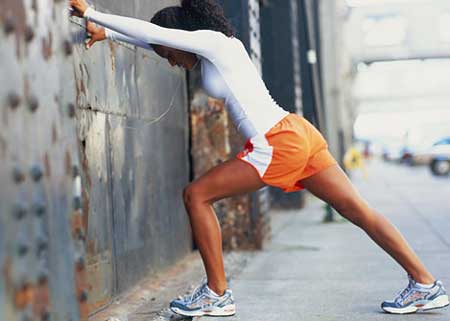
Many runners stretch before and after a workout or a competition. Often they do static stretching, i.e. they strech a muscle by elongating it, in a static posture for 15-30s or more. The idea is that if we stretch a muscle before and after an effort, it will gain power, elasticity, and it will decrease the chances of being injured.
However, you have to admit that the idea lacks of intuitivity: if you extend a rubber band to its maximum capacity and hold it that way for a long time and repeatedly, then when you relax the tension, at some point, you'll notice that it has lost its capacities, that it has become too loose.
Researchers interested in the biomechanics of sport and physical activities tried to show if static stretching had any benefits. What they found out, when results weren't completely negative (I mean not corroborating the hypothesis that static stretching shows an identified benefit), is that things aren't clear. USA Track & Field conducts a study where results about health benefits are... Well, not clear. See the summary published by Gretchen Reynolds in Does stretching before running prevent injuries:
The study, one of the largest of its kind, involved almost 1,400 runners, from age 13 to past 60, who were assigned randomly to two groups. The first group did not stretch before their runs, while otherwise maintaining their normal workout routine: the same mileage, warm-up (minus any stretching) and so on. The second group stretched, having received photographs and specific instructions for a series of simple, traditional poses, like leaning over and touching toes, that focused on the calf, hamstring and quadriceps muscles. The volunteers were told to hold each stretch for 20 seconds, a technique known as static stretching. The entire routine required three to five minutes and was to be completed immediately before a run.
The volunteers followed their assigned regimens for three months. Predictably, since running, as a sport, has a high injury rate, quite a few became injured during the three months. About 16 percent of the group that didn’t stretch were hobbled badly enough to miss training for at least three days (the researchers’ definition of a running injury), while about 16 percent of the group that did stretch were laid up for the same amount of time. The percentages, in other words, were virtually identical. Static stretching had proved to be a wash in terms of protecting against injury. It “neither prevented nor induced injury when compared with not stretching before running,” the study’s authors concluded, raising the obvious corollary, so why in the world do so many of us still stretch?
To continue with the "non-clear" effect, Gretchen Reynolds, in To stretch or not to stretch, gathers some recent studies where it is shown that, if someone maintains the position of a static stretching for less than 30s, she/he will experience no "detrimental effects". Indeed it seems that over that length of time, you are likely to hurt yourself and diminish your capacities. But that leaves open the question of the benefit of static stretching in the less than 30s condition: does it help us to get injury-free? to be more powerful? faster? What's the point of stretching if it doesn't help us in any way?
In Stretching: the truth, Gretchen Reynolds contrasts static stretching and dynamic stretching. It's an interesting read. According to GR and the background studies of this article, the problem with static stretching is that it doesn't fill the required conditions of stretching: i) increasing the range of motion of joints and, ii) warming up body's temperature.
Personally I stretch dynamically before some workouts, but not every time (some samples of dynamic stretching can be found in Stretching: the truth). If you have to run to save your life or save the life of someone, you will not have a hint 15mn before to warm up. You just run when it's needed.
Sunday, 4 December 2011
Running as a global experience
Why do we run ? According to my experience, we run to flee (from an aggressor or from our anxiety), to hunt (a bus when we are late or a deer when we are hungry), to play (with our friends on Saturday morning).

Running is a global experience. With the feelings on my skin, I know the quality of the air; with the feelings on my feet, I know what is right under my feet where I stand. With my eyes I know what is just in front of me. With my nose, I know what I can't see, what is behind the next bush. With my ears, I know how things move in any direction, especially what is behind me and on my sides. The touch for the present and where I stand; the hearing for the past and what is behind me and on my sides; the view for the short-term future and what is right in front of us; the smell/ taste for the long-term future and what is far ahead.
Being mindful of my sensory system helped me to get rid of pressure of performance, and improved my technique and posture. Indeed I think we have this finely atune and precise global sensory system for one and only one thing: to adapt, to adjust to our environment. It's not our will or desires that shape our behavior, but the interaction between our capacities and the environment. It's not a pair of shoes with flying wings that dictates if I can run fast everywhere, but how my body can react to my environment with its capacities. If you start thinking about how it hurts to run on sharp rocks, and start thinking about the reason behind this kind of pain (I mean ache not suffering), you begin to realize that your sensory system is not just bothering you and preventing you to achieve your PR, but telling you how to adjust to your environment with the capacities you have. The interaction between the environment and our capacities show us how we can adapt to the features of our environment with efficiency and safety. (Consequence: don't mess with things that alter your sensory system and your brain chemistry, or seclude your sensory system from its environment.)

Tuesday, 8 November 2011
The 100-up exercise for proper running technique and posture
Christopher McDougall, author of Born to Run, published a paper in the New York Times where, among many other things, he describes a good training to obtain a proper technique and a good posture: the 100-up exercise. With his talent as a narrator, he narrates how he digged up this secret, from W. G. George. Here is the description of the exercise:
He then published two blog posts related to injuries, posture and the 100-up exercise: the barefoot MD, in his own words, 100-up and the vampire bite (aka, plantar fasciitis).
Some interesting comments on McDougall's post:
The 100-Up consists of two parts. For the “Minor,” you stand with both feet on the targets and your arms cocked in running position. “Now raise one knee to the height of the hip,” George writes, “bring the foot back and down again to its original position, touching the line lightly with the ball of the foot, and repeat with the other leg.”Here is Christopher McDougall showing how it's done:
That’s all there is to it. But it’s not so easy to hit your marks 100 times in a row while maintaining balance and proper knee height. Once you can, it’s on to the Major: “The body must be balanced on the ball of the foot, the heels being clear of the ground and the head and body being tilted very slightly forward. . . . Now, spring from the toe, bringing the knee to the level of the hip. . . . Repeat with the other leg and continue raising and lowering the legs alternately. This action is exactly that of running.”
He then published two blog posts related to injuries, posture and the 100-up exercise: the barefoot MD, in his own words, 100-up and the vampire bite (aka, plantar fasciitis).
Some interesting comments on McDougall's post:
Friday, 21 October 2011
Systema, femmes et self-défense
Un article intéressant sur les femmes, le systema et le self-défense. Le systema n'est ni un art martial (un ensemble de techniques, de valeurs philosophiques et spirituelles destinées à aider un individu dans son cheminement personnel), ni un sport de combat (une préparation physique, morale et mentale pour une compétition en combat dans des conditions légales acceptées par les deux parties), mais un forme de self-défense (voir l'article sur Wikipedia sur le Systema, qui est assez bien fait). Le but est d'ouvrir les yeux des gens sur la réalité de l'agression (eux-mêmes, les agresseurs, l'environnement) pour pouvoir sauver sa peau en cas de situation de prédation. À titre d'exemple, voici une vidéo d'exercices de systema de défense au couteau où le scénario est: les deux individus ont un couteau placé dans leur ceinture:
Pour revenir au sujet qui nous intéresse, j'extraie quelques passages qui me paraissent intéressants:
Les gens cherchent à se protéger parce qu'ils sont effrayés. C'est justement la peur qui est la racine du problème. Généralement nous connaissons seulement la peur du point de vue de la victime potentielle. Mais la peur existe aussi de l'autre coté, l'agresseur est également effrayé. A présent vous êtes sceptique et je vais vous donner trois scénarios.
Un voleur veut votre montre.
1- Si vous êtes assoupi, il se faufilera, la dérobera et partira. Vous ne le sentirez même pas.
2 -Si vous êtes malade ou saoul, il pourra proposer de vous aider et prendre la montre à votre poignet ou bien l'arracher et vous pousser à terre.
3 -Si vous marchez dans la rue droit en pleine santé, c'est à peu près sur qu'il vous blessera. Il pourra vous sauter dessus agressivement, sortir une arme et si vous donnez pas votre montre, vous finirez blessé ou mort.
D'où provient l'acte d'agression du cas de figure ? De la peur qu'il n'arrivera pas à ses fins, que vous puissiez le blesser, le contenir jusqu'à l'arrivée de la police ou même le tuer. L'agression découle de la peur. [...] La source de ce besoin destructeur peut aussi être la peur ressentie par l'agresseur.
Un prédateur (j'exclue les cas d'agression dans le cadre de l'établissement d'une hiérarchie sociale) est un individu rationnel: le but de l'agression est d'obtenir ce qu'il veut de manière rentable: maximum de dégâts pour l'agressé et minimum de dégâts pour lui. Et c'est la peur que la prédation se retourne contre lui qui entraîne l'agresseur à choisir le moment où l'agressé potentiel est le plus vulnérable.
Un peu plus loin, sur les femmes, l'agression et le Systema:
L'art martial russe devrait être le choix des dames pour plusieurs raisons.-Les traits uniques du Systema, tels que les mouvements naturels et la prise de conscience de ses propres forces et faiblesses permettent aux femmes de s'adapter rapidement même si elles sont complétement étrangères au combat.-Les femmes peuvent progresser comme les hommes, elles progressent souvent plus rapidement que la plupart des hommes.-Étant souvent plus menues et plus faibles physiquement que les hommes, les femmes vont trouver les principes de non-résistance et d'immersion dans le mouvement très naturel, alors que les hommes auront plus de difficultés avec cet aspect.-Utiliser l'inertie pour manipuler le corps de l'adversaire n'est pas difficile pour les femmes. C'est le seul moyen pour qu'elles puissent travailler avec un grand gabarit.-Une plus grande mobilité naturelle des tendons, la flexibilité et des mouvements gracieux sont des des avantages en Systema.-De plus le Systema offre la liberté de découvrir les meilleures réponses à tout types d'attaques, permet d'apprendre à gérer la panique, à chuter et rouler sans dommages, à compenser le manque de force brute par des mouvements correctes et l'acuité, à améliorer sa conscience de l'espace, à éviter les endroits et les situations dangereuses...
Le Systema joue à la fois la carte de la psychologie (on fait face à ses propres peurs et aux limites de notre système moral: tomber, prendre un coup, faire mal à quelqu'un, la panique, etc) et la carte de l'entraînement physique. Les hommes sont souvent pris au jeu de la force. Les rites d'établissement de hiérarchie sociale, fondés sur la force (comme la monkey dance) sont très ancrés chez les hommes. C'est pourquoi, en cas d'agression ou de prédation, ils ont tendance à utiliser la force. Or, le prédateur a de nombreux avantages: il a choisi un environnement qui rend l'agressé vulnérable, il aura sans doute prévu une arme, avant même que l'agressé comprenne qu'il est une victime l'agresseur l'a déjà sans doute atteint plusieurs fois, etc. Un individu déjà atteint, vulnérabilisé, ne peut plus compter sur la force pour s'en sortir. Les premiers obstacles sont psychologiques : la panique (argh! j'ai été touché malgré mes 10 ans d'entraînements en karaté!), l'acceptation de prendre des coups, la volonté de croire qu'on va s'en sortir. Femmes et hommes sont concernés. Et ce n'est pas la force physique qui permet de dépasser ce genre d'obstacles.
Wednesday, 12 October 2011
Free climbing
Urban free climbing:
Free climbing in natural environment (Patrick Edlinger, la Vie au bout des doigts):
Patrick Edlinger La vie au bout des doigts from Yak! on Vimeo.
Free climbing in natural environment (Patrick Edlinger, la Vie au bout des doigts):
Patrick Edlinger La vie au bout des doigts from Yak! on Vimeo.
Subscribe to:
Posts (Atom)